
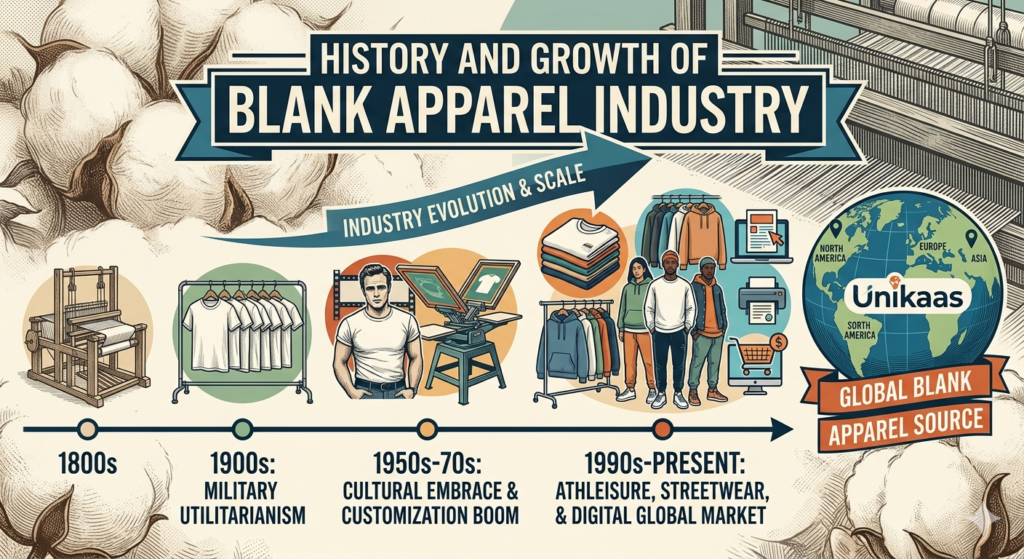
The Foundations of Blank Apparel – Historical Roots and the Industrial Revolution
The modern wardrobe relies on a quiet, versatile foundation: the blank canvas of apparel. Long before billions of garments were stamped with logos, direct-to-garment prints, or intricate embroidery, clothing served strictly utilitarian, protective, and cultural roles. To truly understand the meteoric rise, widespread reach, and multi-billion-dollar scale of the contemporary blank apparel sector, we must trace its evolution back to its humble beginnings. This journey begins centuries ago, tracking how shifting textile technologies transformed basic undergarments into an independent, thriving global market.
The Origins of Undershirts and Layering
For much of recorded history, what we now consider a “blank t-shirt” or a “plain hoodie” simply did not exist as outerwear. In ancient Rome and throughout the Middle Ages, citizens wore tunics and shifts. These lightweight linen or wool garments were worn closest to the body, shielding costly, decorative outer robes from sweat and skin oils. They were completely unadorned, hidden from public view, and valued entirely for hygiene and basic insulation.
By the 19th century, this concept crystallized into the one-piece knit union suit. Typically made of heavy wool or flannel, the union suit covered the wearer from wrists to ankles. While functional for laborers working in harsh, cold climates, it was notoriously restrictive and uncomfortable during seasonal transitions.
The true breakthrough occurred when textile manufacturers decided to split the union suit into separate top and bottom components. Laborers quickly realized that the top half, which could be tucked into trousers, offered unprecedented upper-body mobility. This separation laid the groundwork for the independent manufacture of plain, utilitarian knitwear, paving the way for what would eventually become the staple of modern streetwear and promotional merchandise.


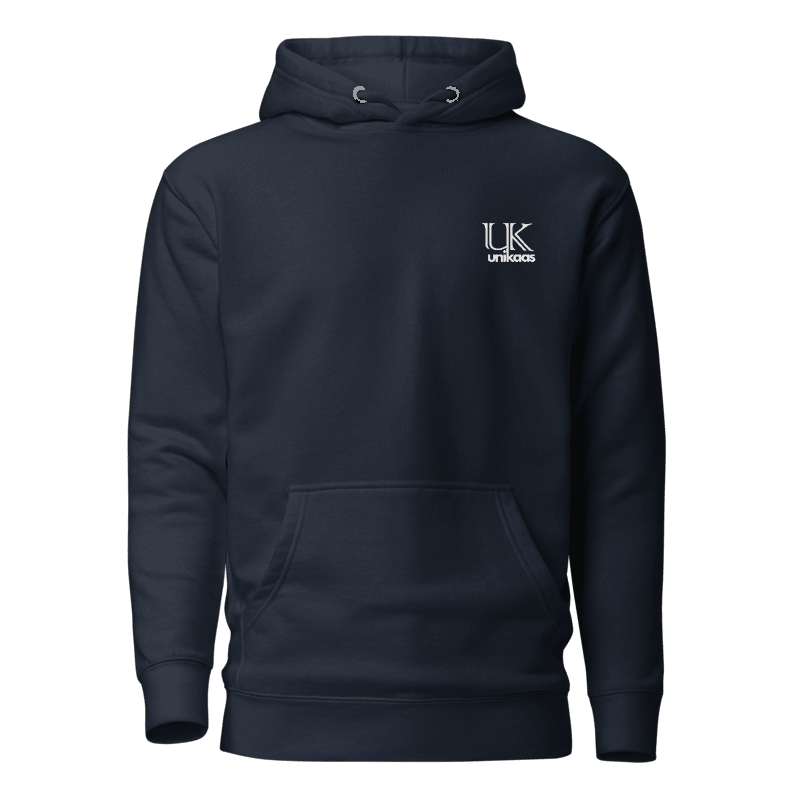
Get Custom Quote Now
The Industrial Revolution: From Hand Looms to Mass Production
The transformation of these rudimentary undergarments into a systematic, scalable industry was driven by the Industrial Revolution. Before the late 18th century, spinning yarn and weaving cloth were manual, labor-intensive processes confined to domestic cottage industries. The invention of the spinning jenny by James Hargreaves, followed by Eli Whitney’s cotton gin and the development of steam-powered mechanized looms, changed everything.
These innovations automated the processing of raw cotton fibers into uniform, strong, and scalable yarns. Suddenly, fabric could be produced at a fraction of the traditional time and cost. The shift from woven fabrics to circular knitting technology was especially crucial for blank apparel.
Circular knitting allowed factories to produce continuous, seamless tubes of jersey fabric. This eliminated the need for side seams in basic shirts, drastically reducing production times, optimizing fabric utilization, and improving next-to-skin comfort for wearers. As supply chains industrialized, specialized textile hubs emerged globally, laying the groundwork for businesses looking to purchase shirts in bulk at highly accessible price points.
The Turn of the Century and Military Standardization
The transition of the plain white tee from a hidden undergarment to a standardized piece of military kit marked a pivotal turning point for the industry. In 1913, the United States Navy officially adopted a lightweight, crew-neck, short-sleeve white cotton undershirt as part of its standard-issue uniform.
[Late 1800s: Split Union Suits]
       │
       ▼
[1913: US Navy Standardized White Undershirt]
       │
       ▼
[1920s: Introduction of the Term "T-Shirt" (Fitzgerald)]
       │
       ▼
[1930s: Hanes & Fruit of the Loom Commercial Bulk Supply]
The military had clear, practical reasons for this decision:
- Hygiene and Care: Plain white cotton was exceptionally easy to launder, boil, and bleach in bulk aboard naval vessels.
- Temperature Regulation: Sailors working in stifling engine rooms or tropical decks could strip off their heavy uniform jackets and work comfortably in just their breathable undershirts.
- Cost Efficiency: The simple, boxy pattern required minimal stitching, allowing government contractors to manufacture millions of units quickly and affordably.
Shortly after, around 1920, author F. Scott Fitzgerald famously immortalized the word “T-shirt” in his debut novel, This Side of Paradise, bringing the term into the mainstream vocabulary. Recognizing a massive commercial opportunity, heritage brands like Hanes, Fruit of the Loom, and P.H. Hanes Knitting Company shifted their massive production capacities toward these standalone knit garments.
They set up large-scale B2B distribution networks to supply factories, schools, and athletic clubs. This shift permanently established the foundation for the global blank apparel supply chain we rely on today.
The Mid-Century Metamorphosis – Outerwear, Rebellion, and the Birth of Customization
The mid-20th century brought about a radical cultural and functional shift for plain, unadorned apparel. What started as a standard military undergarment quickly transformed into a powerful symbol of youth rebellion, pop-culture cool, and a blank canvas for self-expression. During this era, the blank apparel industry evolved from a basic commodity market into a multi-tiered ecosystem, designed specifically to fuel the explosive growth of the garment decoration, screen-printing, and merchandise sectors.
Hollywood, Rebellion, and the White Tee as a Statement
When World War II ended, millions of returning soldiers, sailors, and marines continued wearing their comfortable military-issued white undershirts around their homes and local neighborhoods. However, the garment’s true transformation into an iconic standalone fashion statement was driven by Hollywood cinema in the 1950s.
       Marlon Brando                          James Dean
("A Streetcar Named Desire", 1951)      ("Rebel Without a Cause", 1955)
               │                                      │
               └───────────────────┬──────────────────┘
                                   │
                                   ▼
             Cultural Shift: Undergarment to Outerwear
             (Symbol of Youth, Rebellion, and Freedom)
In 1951, Marlon Brando shocked and captivated audiences in A Streetcar Named Desire, wearing a tight, sweat-stained white t-shirt that radiated raw, working-class masculinity. A few years later, in 1955, James Dean cemented this rebellious look in Rebel Without a Cause, pairing a crisp white blank hoodie and a classic white tee with a red jacket and blue jeans.
Almost overnight, the white undershirt shed its associations with manual labor and underwear, becoming the ultimate symbol of youth, defiance, and effortless style. This cultural shift created an unprecedented consumer demand for high-quality, standalone blank garments, prompting manufacturers to re-engineer their products with thicker fabric weights, reinforced collars, and improved fits tailored for outerwear.
The Invention of Plastisol Ink and the Screen-Printing Boom
As the demand for standalone blank shirts surged, a technological breakthrough in the late 1950s completely revolutionized the apparel industry: the invention of plastisol ink. Before plastisol, fabric decoration relied on water-based inks that dried rapidly on printing screens, clogging fine details and requiring laborious, slow production setups.
Plastisol ink, made from PVC particles suspended in a plasticizer, changed the game because it does not dry at room temperature. It only cures when exposed to high heat (around 320°F/160°C). This allowed printers to:
- Leave ink on screens for days without drying out, drastically reducing cleanup times.
- Achieve bright, highly opaque colors on dark fabrics, creating vivid graphic designs.
- Build multi-color rotary screen-printing presses, laying the groundwork for high-speed automated print shops.
This technical milestone turned plain clothing into the ultimate promotional canvas. Suddenly, rock bands, political campaigns, colleges, and corporations were buying wholesale t-shirts in massive quantities, transforming them into mobile billboards for branding and self-expression.
Emergence of the “Blank Canvas” Business Model
With the screen-printing and embellishment industry booming, a new B2B business model emerged: the dedicated blank apparel supplier. Printers and decorators did not want to weave fabric or sew garments themselves; they needed a reliable supply of consistent, affordable, pre-shrunk, and unbranded apparel ready for immediate customization.
+------------------------+      +-------------------------+      +------------------------+
|  Textile Manufacturer  | ---> | Blank Apparel Supplier  | ---> |   Screen-Printer /     |
| (Weaving, Knitting)    |      | (Inventory Management)  |      |   Garment Decorator    |
+------------------------+      +-------------------------+      +------------------------+
                                                                             │
                                                                             ▼
                                                                 +------------------------+
                                                                 |   End Consumer / Brand  |
                                                                 +------------------------+
Brands like Gildan, Fruit of the Loom, and Jerzees stepped up to fill this need. They optimized their entire operations around inventory availability, fabric consistency, and surface smoothness for printing. They introduced standardized sizing, case-pricing systems, and established regional distribution hubs. This allowed local printers to order assorted sizes and colors with incredibly fast turnaround times.
By separating manufacturing from final decoration, this model lowered the barriers to entry for independent clothing brands. It sparked an entrepreneurial wave that continues to shape the modern streetwear, corporate merchandise, and retail fashion landscapes today.
The Athleisure Revolution and Technical Blank Fabrics
As the blank apparel industry entered the late 20th and early 21st centuries, consumer preferences underwent a major shift. The traditional demand for heavy, boxy, 100% cotton garments began to share the spotlight with a new movement: athleisure. Consumers increasingly demanded clothing that seamlessly combined the comfort of sportswear with everyday, versatile style. This cultural shift forced blank manufacturers to innovate, moving beyond basic cotton knits into advanced synthetic fibers, performance fabric blends, and specialized decoration techniques.
The Birth and Evolution of the Hoodie
To understand the rise of modern performance apparel, we must look at the history of the hooded sweatshirt. Originally developed in the 1930s by Knickerbocker Knitting Company (which later became Champion) to keep warehouse workers and laborers warm in freezing upstate New York environments, the hoodie was built for pure utility. It featured heavy cotton fleece, ribbed cuffs, and an integrated hood to lock in body heat.
1930s (Labor Utility)   --->  1970s (Athletic & Hip-Hop) ---> Modern Day (Premium Streetwear)
• Heavy cotton fleece        • High-school sports teams       • Clean lines, drop shoulders
• Built for frozen rooms     • Early B-boy/graffiti culture    • Luxury fleece, unbranded blanks
By the 1970s, the hoodie had evolved into a symbol of athletic prowess and urban subcultures. High-school track teams, college athletes, and early hip-hop breakdancers embraced the garment for its exceptional comfort and anonymity.
Recognizing its massive appeal, the promotional and streetwear industries began demanding high-quality, unbranded plain hoodies for printing. Print shops and independent designers needed thick, premium blanks that could easily handle heavy plastisol prints, intricate embroidery, and high-density puff printing, transforming the humble sweatshirt into a staple of high-end streetwear.
The Shift to Synthetics: Polyester and Moisture-Wicking Innovations
While cotton remained the preferred choice for casual streetwear, the fitness boom of the 1990s and 2000s highlighted its limitations for performance wear. Cotton naturally absorbs moisture, holding onto sweat, becoming heavy, and causing chafing during intense physical activity. This drove the development of synthetic performance apparel, spearheaded by specialized polyester yarn engineering.
Chemical and textile engineers developed extruded polyester fibers with multi-channel cross-sections (such as cruiser or star shapes). Instead of absorbing sweat, these channels pull moisture away from the skin through capillary action, spreading it across the fabric’s outer surface where it evaporates rapidly.
[Sweat Produced on Skin]
         │
         ▼
[Multi-Channel Polyester Fibers]  <--- Capillary action pulls moisture away
         │
         ▼
[Fabric Outer Surface]            <--- Rapid evaporation & temperature regulation
This innovation led to a massive demand for high-performance dri-fit t-shirts bulk supply. Gyms, marathon organizers, corporate sports teams, and workwear brands quickly replaced traditional cotton tees with lightweight, moisture-wicking synthetic blanks that keep wearers cool and dry.
Sublimation Printing and Its Impact on Blank Demand
The rise of polyester performance apparel went hand-in-hand with a major leap forward in fabric decoration: dye-sublimation printing. Unlike traditional screen printing, which deposits a layer of opaque plastisol ink on top of fabric fibers, sublimation uses heat and pressure to permanently fuse dye directly into the molecular structure of synthetic yarns.
- The Scientific Process: Sublimation inks consist of solid dye particles suspended in a liquid medium. When subjected to temperatures around 400°F (204°C) via a heat press, the solid dye instantly turns into a gas without passing through a liquid state. At the same time, the polymer pores of the polyester fabric open up, absorbing this gaseous dye. As the temperature drops, the pores close, locking the brilliant color directly inside the fiber.
- The Production Result: The finished print has zero texture, does not crack, peel, or wash out, and leaves the fabric completely breathable.
+-----------------------------------------------------------------+
|                      Sublimation Advantages                     |
+-----------------------------------------------------------------+
|  No Ink Texture  |  Will Not Crack/Peel  | Maintain Breathability  |
+-----------------------------------------------------------------+
Because sublimation chemistry only bonds with synthetic polymers, it triggered a massive global demand for specialized, high-yield bulk polyester shirts for sublimation. These blanks require bright, consistent white surfaces and ultra-precise manufacturing tolerances, as even a tiny speck of dust or lint can permanently ruin a full-color sublimated design.
Modern Market Segmentation – From Budget to Premium Blanks
Today, the blank apparel industry has evolved far beyond its one-size-fits-all roots. It is now a highly segmented, sophisticated market designed to support a wide range of business models, including promotional giveaways, high-performance athletic lines, and premium retail streetwear. Modern brands no longer look at blank garments as mere commodities. Instead, they choose their blanks strategically based on fabric weight, yarn processing methods, and structural construction to align perfectly with their brand identity.
Promotional vs. Retail Grade: Understanding Yarn Processing
The starkest divide in the blank apparel landscape lies between budget-friendly promotional items and high-end, retail-ready garments. This quality difference is determined right at the start of manufacturing by how the cotton yarns are spun:
Open-End Cotton (Promotional Grade)
Open-end spinning is a highly efficient, high-speed production method where short-staple cotton fibers are twisted together using a fast-moving rotor. While this process keeps manufacturing costs very low, it produces a thicker, rougher yarn with a slightly uneven texture.
Garments made from open-end cotton feel heavier and scratchier against the skin. They also have a more textured surface, which is fine for budget-conscious corporate events or mass promotional giveaways, but less ideal for fine-detail screen printing.
Ring-Spun and Combed Cotton (Retail Grade)
Premium blanks rely on ring-spun and combed cotton. Ring-spun yarns are crafted by continuously twisting and thinning long cotton strands, creating a significantly softer, stronger, and smoother fabric fiber.
To take quality a step further, the cotton undergoes a combing process where specialized fine-toothed brushes comb through the fibers to remove short strands, impurities, and knots. This leaves only the longest, straightest, and most uniform fibers.
Open-End Cotton (Budget/Promo)        Ring-Spun & Combed Cotton (Premium/Retail)
• Short-staple fibers, spun fast       • Long-staple fibers, continuously twisted
• Rough, uneven surface texture       • Ultra-smooth, ultra-soft surface feel
• Ideal for mass promotional events   • Perfect for retail brands & detail printing
The resulting fabric offers an ultra-soft feel and a smooth surface, making it the gold standard for luxury clothing brands, screen-printing shops, and e-commerce stores looking for high-quality retail merchandise.
The Fabric Weight Spectrum: GSM and Ounces
When sourcing blanks, businesses categorize garments based on fabric weight, measured either in ounces per square yard ($\text{oz/yd}^2$) or grams per square meter ($\text{GSM}$). Understanding this spectrum is essential for finding the right option for target audiences and seasonal collections:
| Weight Category | Ounces (oz/yd2) | Grams Per Square Meter (GSM) | Best Common Use Cases |
| Lightweight | 3.0 – 4.5 oz | 100 – 150 GSM | Summer fashion lines, activewear blends, lightweight layering tees. |
| Midweight | 5.0 – 5.5 oz | 170 – 190 GSM | Standard retail merchandise, band merch, classic everyday t-shirts. |
| Heavyweight | 6.0 – 7.5+ oz | 200 – 250+ GSM | Premium streetwear, retro boxy drop-shoulder collections. |
In the sweatshirt category, this differentiation is even more pronounced. Premium streetwear brands frequently pass over lightweight fleece in favor of heavy, structured fabrics. They actively seek out premium blank hooded sweatshirts wholesale options ranging from 400 to 500 GSM. These heavy fabrics provide the structured drape, deep hoods, and cozy feel that consumers expect from modern premium fashion.
The Streetwear Surge: Vintage Blanks and Modern Silhouettes
The meteoric rise of independent e-commerce brands and streetwear culture has fundamentally changed what people look for in a garment’s fit and style. For decades, the market was dominated by standard retail fits featuring narrow shoulders and tapered side seams. Today, however, consumer preferences lean heavily toward retro-inspired aesthetics.
       Traditional Retail Fit                       Modern Streetwear Fit
+----------------------------------+        +----------------------------------+
|  • Narrow, high shoulder seams   |        |  • Dropped shoulder design       |
|  • Tapered, form-fitting sides   |        |  • Boxy, oversized body          |
|  • Lightweight, flexible drape   |        |  • Thick, structured collar band |
+----------------------------------+        +----------------------------------+
This shift has created an explosive demand for the vintage t-shirt blank. These specialized blanks accurately replicate the classic look and feel of 1990s graphic tees, featuring:
- Dropped Shoulders: Wide, relaxed shoulder seams that sit lower on the arm for an effortless, casual look.
- Boxy, Oversized Cuts: A roomier, squared-off body silhouette that delivers comfort without feeling sloppy or ill-fitting.
- Thick Collar Bands: Tight, durable, high-density ribbed collars that hold their shape perfectly and won’t stretch out after multiple washes.
- Pigment Dyeing Processes: A specialized washing and dyeing technique that creates a subtly faded, lived-in color effect, highlighting the garment’s unique seams and texture.
By designing blanks with these classic, high-end details, manufacturers give modern fashion brands everything they need to build high-margin collections that rival luxury streetwear lines.
The Economics of Wholesale Sourcing and Global Supply Chains
The global blank apparel industry relies on a highly efficient, multi-billion-dollar supply chain network. It balances agricultural production, textile engineering, international logistics, and trade regulations to move millions of blank garments from cotton fields to print shops all over the world. For fashion brands, print shops, and corporate buyers, navigating this wholesale landscape requires a clear understanding of production hubs, cost-saving bulk strategies, and international trade dynamics.
+------------------------------------+
|       Raw Material Sourcing        |
|  (Cotton Farming & Processing)     |
+-----------------+------------------+
                  │
                  ▼
+------------------------------------+
|        Yarn & Fabric Spinning      |
|    (Knitting, Dyeing, Finishing)   |
+-----------------+------------------+
                  │
                  ▼
+------------------------------------+
|      Garment Manufacturing         |
|   (Pattern Cutting, Sewing, QC)    |
+-----------------+------------------+
                  │
                  ▼
+------------------------------------+
|     International Logistics        |
|   (Freight, Customs, Warehousing)  |
+-----------------+------------------+
                  │
                  ▼
+------------------------------------+
|     B2B Wholesale Distribution     |
|   (Case Pricing & Bulk Fulfillment)|
+------------------------------------+
Key Global Manufacturing Hubs
The production of blank apparel is concentrated in highly specialized textile manufacturing regions worldwide, each offering its own unique strengths in raw materials, labor, and craftsmanship:
Pakistan
Pakistan is a powerhouse in the global textile arena, globally renowned for its exceptional vertical integration. This means everything from large-scale cotton farming and high-tech spinning mills to cut-and-sew factories happens right within the country.
The region excels in producing incredibly soft, durable jersey fabrics and heavy premium fleece. This makes it a preferred destination for sourcing high-end streetwear blanks, especially through specialized wholesale hoodies Pakistan suppliers who can deliver elite retail quality at highly competitive prices.
Bangladesh
Equipped with massive, modern manufacturing facilities, Bangladesh focuses primarily on high-volume production efficiency. Its factories are optimized to produce millions of classic jersey blanks with exceptional consistency, making it a go-to choice for global retail giants and mass promotional buyers.
Vietnam and China
These hubs stand out for their advanced synthetic manufacturing and technical fabrics. They lead the industry in engineering complex recycled polyester performance blends, water-resistant outer layers, and specialized materials designed for activewear and athleisure brands.
The Mechanics of B2B Wholesale Pricing
Sourcing blank apparel successfully depends heavily on understanding tiered wholesale pricing models. Unlike retail shopping, B2B procurement rewards volume, giving larger businesses a distinct competitive edge:
- Piece Pricing: Buying individual, loose garments. This tier has the highest cost per unit because it requires warehouse staff to manually open cases, pick specific colors or sizes, and repackage them. It is best suited for small sample runs or fill-in orders.
- Case Pricing: Purchasing garments in factory-sealed boxes (usually containing 12, 36, 72, or 144 units of a single size and color). Case pricing lowers the cost per unit, as it optimizes shipping and handling efficiency for warehouses.
- Pallet and Truckload Pricing: The highest tier, tailored for large-scale garment decorators, major retail brands, and industrial screen printers. By committing to thousands of units per order, buyers unlock the lowest possible cost per unit, maximizing their profit margins.
[Piece Pricing]   --> Small sample orders, highest per-unit cost.
       │
       ▼
[Case Pricing]    --> Factory-sealed boxes, optimized warehouse handling.
       │
       ▼
[Pallet Pricing]  --> Industrial scale, maximum volume discounts, lowest cost per unit.
To optimize their inventory costs, businesses frequently mix styles within their orders. For instance, they might combine core short-sleeve options with long sleeve t-shirt blanks to hit higher overall volume tiers, unlocking lower pricing across their entire seasonal order.
Tariffs, Trade Agreements, and Nearshoring Dynamics
International trade policies and logistics play a huge role in shaping how blank apparel is sourced. Import tariffs and customs duties can add unexpected costs, making specific manufacturing regions more or less attractive based on international trade agreements.
       Traditional Offshoring                        Strategic Nearshoring
+----------------------------------+        +----------------------------------+
|  • Long transit times (ocean)     |        |  • Short transit times (overland)|
|  • Higher exposure to tariff risk|        |  • Faster restock flexibility    |
|  • Lowest initial unit production|        |  • Lower tariff/duty barriers    |
+----------------------------------+        +----------------------------------+
Because international shipping lanes can experience unexpected delays or rising container costs, many businesses are adopting nearshoring strategies. Nearshoring involves moving production closer to primary consumer markets.
For instance, UK and European brands often look for strategic nearshore suppliers, partnering with specialized asian clothes wholesale suppliers uk hubs to maintain fast, reliable restock cycles. Sourcing closer to home helps brands avoid long ocean shipping delays, navigate complex customs changes smoothly, and respond instantly to fast-moving streetwear trends.
Regional Focus – Sourcing Infrastructure and Localized Distribution
While global supply chains handle large-scale manufacturing, local B2B distribution hubs are what keep the fashion and print industries moving day-to-day. A screen-printing shop, promotional company, or clothing brand cannot wait months for an international shipment every time they get a new order.
This is where regional hubs come in, acting as the essential bridge between massive global factories and local markets. By keeping large inventories of blank apparel close by, these distributors ensure businesses can access the stock they need with incredibly fast turnaround times.
+---------------------------------------+
|  Global Production Hubs (Pakistan)   |
+-------------------+-------------------+
                    │  Bulk Ocean/Air Freight
                    ▼
+---------------------------------------+
|  Regional Logistics Hubs (Lahore)     |
+-------------------+-------------------+
                    │  Domestic Express Supply
                    ▼
+---------------------------------------+
|  Local Printers & Brands (UK/EU/Global)|
+---------------------------------------+
The Strategic Importance of Localized Hubs
To appreciate the value of regional distribution, consider a city like Lahore, Pakistan. Lahore sits at the center of one of the world’s most productive textile corridors, offering direct access to premium raw materials and highly skilled garment production.
Local manufacturers and distributors in this region have built highly integrated networks to meet the global demand for premium streetwear. By sourcing through specialized wholesale hoodies lahore networks, international brands can connect directly with industrial factories. This proximity cuts out unnecessary middlemen, ensures strict quality control at every stage, and makes it easy to customize fleece weights, fits, and color palettes right on the production floor.
Direct-to-Garment (DTG) Printing and Regional Speed
The rapid growth of print-on-demand (POD) e-commerce stores has changed what businesses look for in regional distribution. Unlike traditional screen printing, where shops order hundreds of shirts at once, DTG and POD models rely on printing single shirts as customer orders roll in.
[Customer Orders Online] ---> [POD Software Triggers Production] ---> [Local Hub Fulfills Blank] ---> [DTG Machine Prints & Ships]
This on-demand model requires regional distributors to maintain deep, consistent stock levels of popular styles, like the iconic gildan t-shirts bulk lines. Having reliable stock nearby means local print shops can source blanks, print designs, and ship finished products to consumers within 24 to 48 hours. This incredible speed helps brands run asset-light business models without needing to manage massive warehouses of their own.
Building Resilient Sourcing Infrastructure
Relying on a single sourcing channel leaves a business vulnerable to stock shortages, shipping delays, or sudden price spikes. Successful apparel brands protect themselves by building smart, multi-layered sourcing networks:
                  [Brand Sourcing Core]
                            │
       ┌────────────────────┴────────────────────┐
       ▼                                         ▼
Primary Sourcing Layer                     Secondary Sourcing Layer
• Large-scale international orders        • Regional local distributors
• Maximum profit margins                  • Immediate inventory access
• Longer lead times                       • Rapid safety stock backup
- The Primary Layer: Brands place large, high-volume orders with international factories months in advance to secure the absolute lowest cost per unit and maximize their profit margins.
- The Secondary Layer: Brands partner with regional distributors close to home. Even if the unit cost is slightly higher, these local suppliers offer immediate access to stock, serving as a reliable backup to refill popular sizes or colors in days rather than weeks.
By combining the cost savings of global manufacturing with the speed of local distribution, apparel businesses build agile, resilient supply chains that can thrive in a fast-changing market.
Future Horizons – Sustainability, Digitalization, and the Next Era of Blank Apparel
As the blank apparel industry looks ahead, it faces an exciting wave of transformation driven by two major forces: environmental sustainability and advanced digital technology. Today’s consumers, print shops, and regulatory bodies are demanding transparency, ethical production, and smart supply chains. The days of treating blank clothing as a cheap, disposable commodity are fading. In its place, a new era is emerging—one focused on circular manufacturing, digital workflow integration, and eco-friendly fabric innovations.
The Green Revolution: Organic Cotton, Recycled Polymers, and Circularity
The shift toward eco-friendly manufacturing is no longer just a niche trend; it is an absolute necessity for modern fashion. Traditional textile production requires significant water, energy, and chemical inputs. To reduce this footprint, blank apparel manufacturers are heavily investing in sustainable alternatives:
Raw Organic Cotton         Recycled PET Bottles       Circular Fabric Regeneration
• Zero synthetic pesticides • Plastic diverted from oceans • Old garments shredded & spun
• Reduced water footprints  • Melted into polyester yarn  • Infinite lifecycle potential
- Certified Organic Cotton: Growing organic cotton eliminates synthetic pesticides and chemical fertilizers, protecting local soil and water ecosystems. Organizations like the Global Organic Textile Standard (GOTS) provide strict certifications, giving brands peace of mind that their garments are ethically and sustainably produced from seed to stitch.
- Recycled Polyester (rPET): To reduce plastic waste, manufacturers are turning to recycled polyester made from post-consumer plastic bottles. These bottles are cleaned, shredded into small flakes, melted down, and spun into high-performance, moisture-wicking yarns. This process gives activewear brands top-tier technical performance while keeping plastic waste out of oceans and landfills.
- Circular Design Frameworks: The future of apparel is circular. Forward-thinking manufacturers are designing garments with their entire lifecycle in mind—using single-fiber materials (like 100% organic cotton or 100% recycled polyester) and removable tags to ensure clothing can be easily broken down, shredded, and spun back into new yarn at the end of its life.
Digital Transformation: Smart Warehousing and Web3 Integration
Technology is fundamentally changing how blank apparel is tracked, managed, and distributed worldwide. Managing millions of garments across multiple sizes, colors, and locations requires cutting-edge digital solutions:
RFID Tracking and Smart Warehousing
Modern fulfillment hubs use Radio Frequency Identification (RFID) tags to track inventory with incredible accuracy. Unlike traditional barcodes that must be scanned one by one, RFID readers can scan an entire pallet of mixed garments instantly. This eliminates picking errors, provides real-time stock updates for e-commerce platforms, and keeps supply chains running smoothly.
[Traditional Barcodes] ---> Manual line-of-sight scanning, slower updates, higher error risk.
[Modern RFID Tags]     ---> Instant wireless bulk scanning, real-time inventory visibility.
Digital Passports and Product Transparency
As supply chain transparency becomes a global priority, brands are turning to digital passports powered by QR codes or NFC chips woven directly into garment tags. By scanning the code, consumers can view the item’s entire journey—from the cotton field where it was harvested to the environmental footprint of the factory that sewed it. This transparency builds deep trust with eco-conscious consumers and helps retail brands clearly verify their sustainability claims.
Strategic Sourcing for the Future
The global blank apparel industry has come a long way—evolving from simple military undershirts to a highly sophisticated, technologically advanced market. For independent designers, print shops, and large corporations alike, choosing the right manufacturing partner is the ultimate key to long-term success.
                         [Unikaas Partnership]
                                   │
       ┌───────────────────────────┼───────────────────────────┐
       ▼                           ▼                           ▼
Premium Quality Blanks      Ethical Production          Global Distribution
Smooth, print-ready surfaces Vertical integration hubs Fast, reliable fulfillment
This is where partnering with an industry leader like Unikaas makes all the difference. Combining world-class manufacturing expertise with deep roots in top textile hubs, Unikaas provides a premium, versatile selection of garments—from classic wholesale t-shirts to retail-ready, structured fleece collections.
By prioritizing exceptional fabric quality, reliable stock availability, and a strong commitment to ethical production, Unikaas gives businesses the perfect blank canvas to bring their creative designs to life, scale their brands, and grow with confidence in tomorrow’s fashion landscape.
